
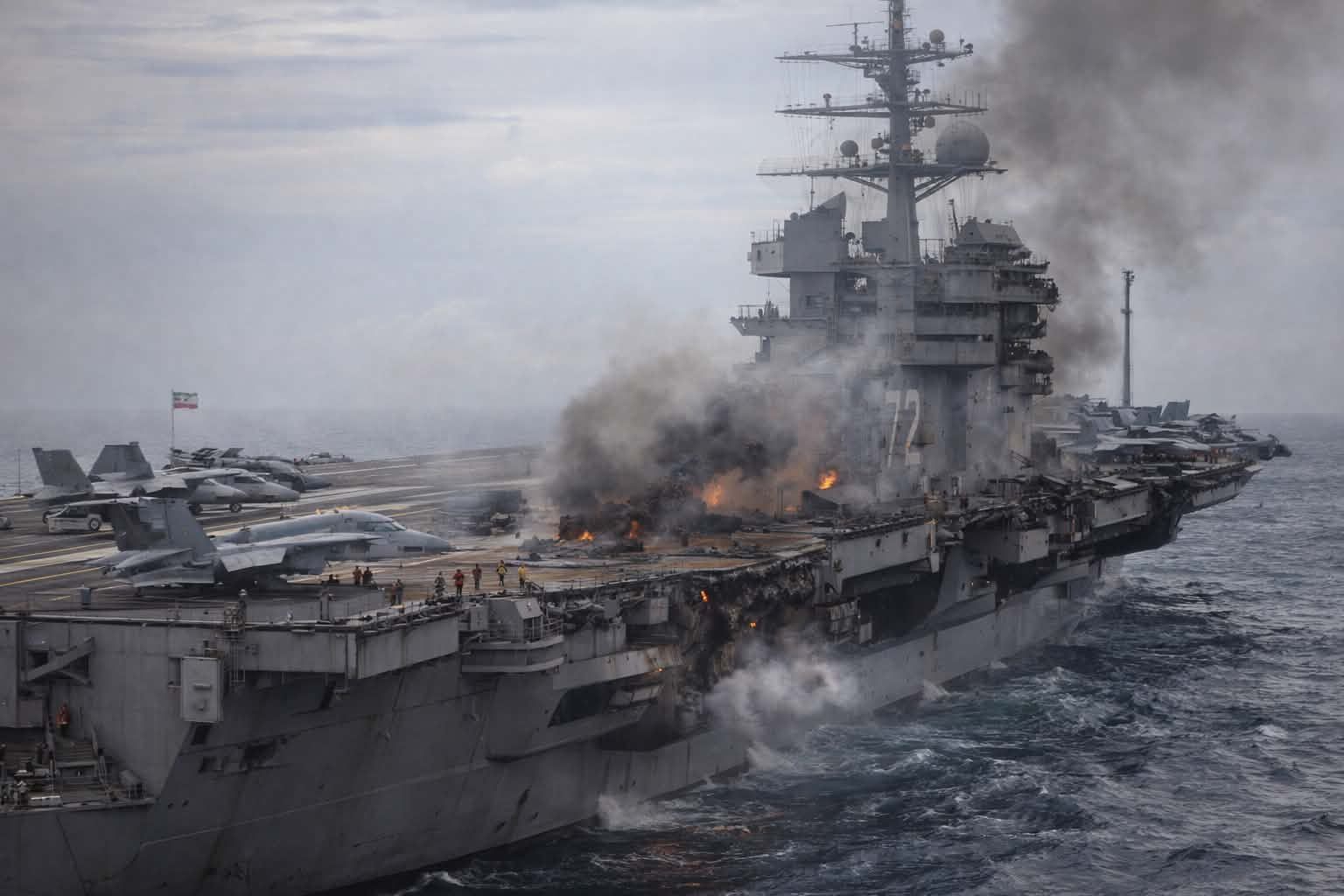
In the high-stakes environment of 21st-century geopolitics, the aircraft carrier remains the ultimate symbol of American power projection. Recently, the USS Abraham Lincoln (CVN-72) has been at the center of a storm—not just in the physical waters of the Middle East, but in the digital landscape of social media. Viral images and headlines claiming the “Naval Giant” is under attack or has suffered catastrophic damage have flooded platforms like Facebook, X (formerly Twitter), and Telegram.
To understand what is actually happening, one must look past the sensationalist thumbnails and dive into the history of the Lincoln, its current mission in the Red Sea and Gulf of Oman, and the sophisticated “Information Warfare” currently being waged by state and non-state actors.
The Legend of the USS Abraham Lincoln (CVN-72)
Commissioned in 1989, the USS Abraham Lincoln is the fifth Nimitz-class aircraft carrier. Named after the 16th President of the United States, the ship is essentially a floating city, home to over 5,000 personnel and capable of carrying up to 90 aircraft, including the F-35C Lightning II.
The Lincoln has a storied history. It played a pivotal role in Operation Desert Shield and Desert Storm, led the humanitarian response to the 1991 eruption of Mount Pinatubo, and was the platform for the famous “Mission Accomplished” speech in 2003. Its massive 4.5-acre flight deck and nuclear propulsion allow it to remain at sea for decades without refueling, making it a persistent threat to any adversary.
The Current Mission: A Powder Keg in the Middle East
The reason the USS Abraham Lincoln has become a target for “fake news” and viral clickbait is its current deployment. In late 2024 and through early 2026, the Lincoln has been stationed in the U.S. Central Command (CENTCOM) area of responsibility. Its mission is clear: to deter regional escalation, protect international shipping lanes from Houthi rebel attacks in the Red Sea, and provide a “shield” for allies.
Because the ship is actively engaged in intercepting drones and missiles, it has become a focal point for propaganda. When Houthi forces claim to have targeted a U.S. carrier, digital “troll farms” often create AI-generated images—like the one showing the Lincoln on fire—to give the appearance of a successful strike. These images are designed to go viral, creating a sense of vulnerability where none exists.
Deconstructing the Viral Claims: How to Spot a “Fake Attack”
The image circulating in the link provided (subfeed.onrender.com/p/y0p0) features several red flags that experts use to identify misinformation:
-
AI Artifacts: In many of these viral photos, the “smoke” doesn’t follow the laws of physics or wind patterns. The hull numbers (72) often look distorted or appear in the wrong place.
-
Lack of Official Confirmation: If a U.S. aircraft carrier—a $13 billion asset—were truly on fire, it would be the lead story on every major global news network within minutes.
-
The “Bridge” URL: The link uses a free hosting service (onrender.com). Official military or reputable news reports would never be hosted on a temporary, free-tier developer platform. These links are often used to harvest clicks or deliver malware.
The “Unsinkable” Nature of a Nimitz-Class Carrier
A major reason why these viral “attack” claims are often physically impossible is the sheer durability of the ship. A Nimitz-class carrier is not just a ship; it is a layered defense system.
-
The Carrier Strike Group (CSG): The Lincoln never travels alone. It is surrounded by destroyers (like the Arleigh Burke-class), cruisers, and submarines. These “escorts” use the Aegis Combat System to shoot down incoming threats long before they reach the carrier.
-
Compartmentalization: Even if a carrier were hit, the hull is double-layered and divided into hundreds of watertight compartments. It is designed to survive multiple torpedo or missile hits while remaining operational.
-
Damage Control: The crew undergoes “General Quarters” drills daily. They are global experts in fire suppression and structural repair at sea.
The Rise of Information Warfare
Why do people create these fake “USS Abraham Lincoln Under Attack” posts? The answer is “Grey Zone Warfare.” By spreading the image of a burning U.S. carrier, adversaries hope to:
-
Lower Morale: Make the American public question the safety of their service members.
-
Recruitment: Use the “victory” images for propaganda in local regions to recruit fighters.
-
Economic Disruption: Spread fear in the shipping industry, which can cause insurance rates for cargo ships to spike.
For the average social media user, these posts are often “engagement bait.” Pages like “Missing.vd” use shocking imagery to drive clicks to their websites, where they generate ad revenue. This is why the headline is often “See More” or “Shocking Video”—it exploits the user’s curiosity.
The Human Element: Life Aboard the Lincoln
Behind the sensationalized headlines are 5,000 men and women working 12-to-18-hour shifts. Life on the Lincoln during a high-tension deployment is grueling. Sailors on the flight deck—the most dangerous workplace in the world—must coordinate the launch and recovery of jets every few minutes.
While the internet debates whether the ship was “hit,” the crew is actually focused on the reality of the mission: keeping the Suez Canal open and ensuring that global trade continues to flow. The mental toll of being the target of global propaganda is a new challenge for the modern sailor, who can see fake reports of their own “demise” on their phones during their off-hours.
Looking Ahead to 2026
As naval technology evolves, the threats will become more real. Hypersonic missiles and massive drone swarms are challenges the Navy takes seriously. However, as of today, the USS Abraham Lincoln remains a fully operational, dominant force in the water.
The battle for the “truth” is now just as important as the battle for the seas. When you see a post claiming a major military disaster, it is essential to cross-reference it with credible sources. In the age of AI, seeing is no longer believing.
Conclusion
The USS Abraham Lincoln is safe, operational, and continuing its mission. The “attack” images are a testament to the power of modern digital manipulation rather than a reflection of military reality. By understanding the capabilities of the carrier and the motives behind fake news, we can better navigate the complex world of modern conflict.