
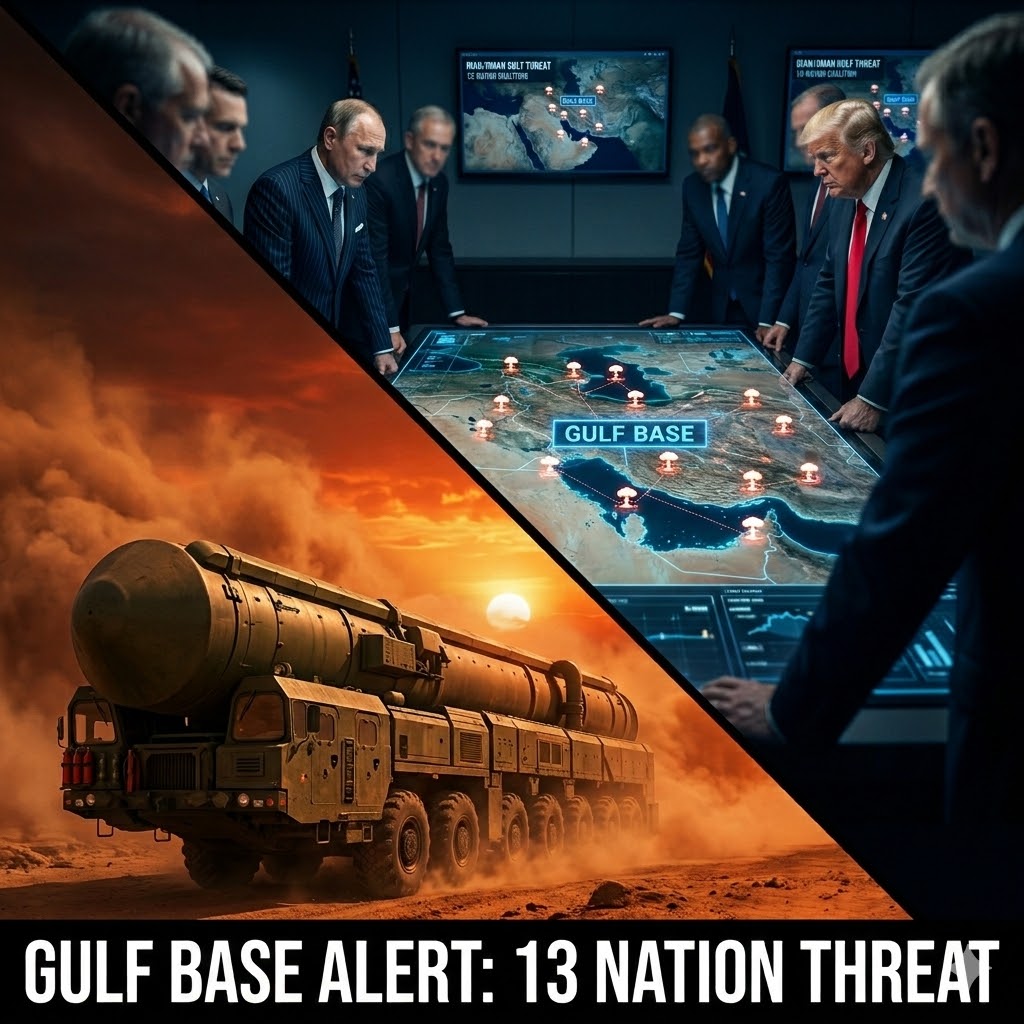
The geopolitical landscape of the Persian Gulf is currently undergoing its most volatile shift since the early 1990s. While mainstream media cycles focus on domestic politics, a quiet but deadly buildup of regional tensions has placed US military assets on a state of high alert. Reports are surfacing of a multi-national realignment that could fundamentally challenge the decades-long hegemony of the United States in the Middle East.
The Strategic Heartland: Why the Gulf Matters
To understand the gravity of the current threat, one must understand the stakes. The Persian Gulf is not merely a body of water; it is the central nervous system of the global energy economy. With the Strait of Hormuz serving as a chokepoint through which 20% of the world’s petroleum passes daily, any threat to regional stability is a threat to the global financial system.
The US military presence in the region, anchored by massive installations like Al Udeid Air Base in Qatar and the Fifth Fleet in Bahrain, has traditionally served as a deterrent against state-sponsored aggression and non-state actors. However, as “13 countries” and various regional factions begin to recalibrate their alliances, the “deterrent” is increasingly being viewed as a “target.”
Historical Context: From the Carter Doctrine to Modern Day
The United States’ commitment to the Gulf was codified in the 1980 Carter Doctrine, which stated that any attempt by any outside force to gain control of the Persian Gulf region would be regarded as an assault on the vital interests of the USA. This policy led to the massive infrastructure of bases we see today.
Over forty years, this presence has evolved from a defensive posture into a complex web of logistics, surveillance, and rapid-response capabilities. However, history shows that such dominance often invites a “counter-balancing” effect. We are now seeing the emergence of a multi-polar threat environment where traditional adversaries are finding common ground in their desire to see a US withdrawal from the region.
Anatomy of the Current Threat: Missile Proliferation and Proxy Warfare
The most immediate concern for military planners is no longer a conventional blue-water navy battle. Instead, it is the democratization of high-precision weaponry. Short and medium-range ballistic missiles, combined with the “suicide drone” revolution, have leveled the playing field.
-
The Drone Dilemma: Small, inexpensive loitering munitions can now bypass multi-million dollar radar systems. These “asymmetric” threats allow smaller nations or proxy groups to inflict massive damage on expensive US aircraft and infrastructure with minimal investment.
-
Integrated Missile Networks: Intelligence suggests that regional actors have integrated their missile batteries, creating a “ring of fire” that could theoretically overwhelm the Patriot and THAAD (Terminal High Altitude Area Defense) systems currently protecting US bases.
The Shadow of Global Superpowers
While regional players are the immediate actors, the presence of major powers like Russia and China looms large in the background. The imagery of world leaders alongside mobile missile launchers—such as the Topol-M or Yars systems—symbolizes a shift toward high-stakes brinkmanship.
Russia’s increasing involvement in Middle Eastern security affairs, particularly through its Mediterranean presence and its partnerships in the Levant, provides regional actors with a sophisticated alternative to Western intelligence and hardware. Meanwhile, China’s economic “Belt and Road Initiative” incentivizes Gulf nations to seek security guarantees that don’t come with the political strings often attached to US military aid.
Technical Analysis: The Vulnerability of Key Bases
If a coordinated attack were to occur, several key locations are currently deemed “high-risk”:
-
Al Udeid Air Base (Qatar): Housing the CAOC (Combined Air Operations Center), this is the brain of US airpower in the region. Its centralized nature makes it a “crown jewel” target.
-
Camp Lemonnier (Djibouti): While technically in the Horn of Africa, its proximity to the Bab-el-Mandeb strait makes it critical for Gulf security.
-
Naval Support Activity Bahrain: Home to the US Fifth Fleet, this base is within easy range of coastal missile batteries.
Defense analysts suggest that the “saturation” of these environments with electronic warfare (EW) could jam communications, leaving these bases “blind” in the opening minutes of a conflict.
Social and Economic Impact: The $200 Barrel of Oil
The “social impact” of a conflict in the Gulf cannot be overstated. Should US bases come under direct, sustained fire, the insurance rates for commercial shipping would skyrocket overnight. Experts predict that a prolonged disruption in the Strait of Hormuz could send oil prices soaring toward $200 per barrel, triggering a global recession that would dwarf the 2008 financial crisis.
Furthermore, the social stability of the Gulf states themselves is at risk. Many of these nations rely on the “security umbrella” of the US to maintain internal order and economic investment. A perceived weakness in that umbrella could lead to domestic unrest and a rapid flight of capital.
Future Projections: The Path Toward De-escalation or Disaster
As we look toward the next 24 to 36 months, two paths emerge.
Path A: The Diplomatic Pivot. A new regional security framework is established that includes all major Gulf players, potentially reducing the need for a massive US “boots on the ground” presence. This would require a level of diplomatic finesse not seen in decades.
Path B: The Kinetic Escalation. A miscalculation—a downed drone, a misinterpreted exercise, or a proxy strike that goes too far—triggers a chain reaction. With 13 or more nations potentially involved in the fallout, a localized skirmish could transform into a “Great Power” confrontation.
Technical Specs: The Defensive Shield
To counter these threats, the US is fast-tracking the deployment of Directed Energy Weapons (lasers) and AI-driven interceptors. These systems are designed to engage dozens of targets simultaneously, theoretically providing a “hard kill” capability against the drone swarms mentioned earlier.
However, the “cost-per-kill” ratio remains a major hurdle. It costs hundreds of thousands of dollars to fire an interceptor at a drone that may have cost only $2,000 to manufacture. This economic attrition is a core component of the current strategy being used against US interests in the Gulf.
Conclusion
The threat to US military bases in the Gulf is not a static reality; it is an evolving, multi-dimensional challenge that combines 21st-century technology with ancient geopolitical rivalries. Whether through “Regional Precautions” or “Global Updates,” the world must remain vigilant. The stability of our global economy and the lives of thousands of service members depend on a clear-eyed assessment of these emerging dangers.