
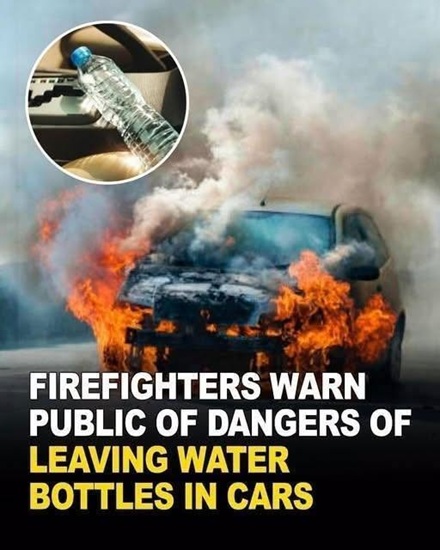
On a hot summer day, it is common to leave a vehicle parked under direct sunlight while running errands or working. Many people leave behind small items such as a half-empty plastic water bottle in the cup holder without a second thought. While this habit is extremely common, it has sparked widespread online claims suggesting that such objects can act as fire hazards inside a parked car. The reality is more nuanced. A clear plastic bottle filled with water can technically refract and focus sunlight, similar to a basic lens.
Under very specific conditions, this can create a small, concentrated point of heat on a surface. However, real-world studies and fire investigations show that this effect is usually too weak, inconsistent, and short-lived to ignite modern car interiors on its own. Even so, the discussion highlights an important truth: cars can become dangerously hot environments during summer, and small overlooked items can still contribute to discomfort, damage, or in rare cases, safety risks.
How Sunlight Interacts With Objects Inside a Car
When sunlight enters a parked vehicle, it passes through glass and becomes trapped, gradually increasing the internal temperature. This greenhouse effect is well documented and can raise cabin temperatures to extreme levels within a short time, especially in direct sunlight.
A clear plastic bottle filled with water can bend and focus light due to its curved shape and the refractive properties of water. In theory, this can create a concentrated beam of light onto a surface, similar to how a magnifying glass works. However, the intensity of this beam depends on many variables, including angle, bottle shape, water clarity, sunlight position, and surface distance.
Because cars are constantly shifting environments—sun angle changes, shadows move, and bottles are rarely positioned perfectly—the focused beam is unstable. This makes sustained heating at a single ignition point extremely unlikely in normal conditions.
Why the “Car Fire From Water Bottle” Story Spread Online
The idea that a simple water bottle can start a car fire became popular through viral posts, social media warnings, and exaggerated safety stories. These posts often show dramatic descriptions of melted dashboards or burning seats, suggesting a direct cause-and-effect scenario.
In reality, professional fire investigations overwhelmingly identify other causes of vehicle fires. These include electrical system failures, fuel leaks, overheating engine components, or aftermarket modifications. Passive sunlight refraction from bottled water is not considered a common ignition source.
However, like many viral safety claims, this one persists because it contains a partial truth: sunlight can be focused through transparent materials. That scientific fact gets stretched into a much more dramatic conclusion than evidence supports.
The Real Risk: Extreme Heat Inside Parked Cars
Although water bottles are not a proven fire hazard in typical conditions, the broader issue is far more serious: heat accumulation inside vehicles.
On a sunny day, the interior of a parked car can easily exceed 60°C (140°F), and in extreme conditions even higher. These temperatures can cause significant changes in materials and objects left inside:
- Plastic components can soften or warp
- Electronic devices may overheat or degrade
- Aerosol cans and lighters may become unstable under pressure
- Food and drink can spoil rapidly
- Adhesives and coatings inside the car may weaken
This environment is not just uncomfortable—it can also accelerate wear and damage to interior materials over time.
Flammable and Heat-Sensitive Items Commonly Left in Cars
While water bottles are relatively harmless, other everyday objects can pose more realistic risks when exposed to extreme heat.
For example, aerosol cans such as deodorants or cleaning sprays contain pressurized gas that expands when heated. In very hot conditions, these containers can rupture or leak. Similarly, lighters can become dangerous due to internal pressure changes.
Lithium-ion batteries found in phones, power banks, or devices are also sensitive to heat. Prolonged exposure to high temperatures can reduce battery life, cause swelling, or in rare cases lead to thermal runaway if already damaged.
These risks are more scientifically supported than the water bottle fire scenario and represent a more practical reason to avoid leaving certain items in a parked car.
The Importance of Preventing Interior Damage
Even if the risk of fire from a water bottle is extremely low, leaving clutter in a car during hot weather can still lead to unwanted consequences. Sunlight can fade upholstery, crack dashboards, and weaken interior surfaces over time.
Small objects like plastic bottles, wrappers, or reflective materials can also leave marks or impressions when exposed to prolonged heat. In rare cases, concentrated sunlight may cause localized discoloration or minor surface damage, even if it does not result in ignition.
This makes routine cleanup of a vehicle not just a safety habit, but also a maintenance practice that helps preserve its condition and value.
A More Realistic Safety Perspective
Fire safety experts generally emphasize that while theoretical lens effects exist, they are not considered a significant threat in everyday vehicle use. The conditions required for ignition are too precise and unlikely in a real-world scenario.
However, the broader message behind these warnings still holds value: a clean and organized vehicle reduces risks of multiple kinds, even if not the specific dramatic scenario often described online.
Good safety habits include removing unnecessary clutter, avoiding leaving pressurized or heat-sensitive items inside the car, and using sun protection methods like windshield shades to reduce interior temperature buildup.
Practical Steps for Safer Summer Parking
Instead of focusing on rare and unlikely events, a more practical approach is to minimize heat-related stress on both the vehicle and its contents.
Parking in shaded areas whenever possible can significantly reduce interior temperatures. Using reflective sunshades helps block direct sunlight from heating dashboards and seats. Keeping windows slightly ventilated (when safe) can also help reduce heat buildup.
Most importantly, removing personal items from the vehicle—especially electronics, food, and pressurized containers—ensures that nothing inside is unnecessarily exposed to extreme heat conditions.
Between Myth and Reality
The story of a water bottle starting a car fire is a good example of how scientific facts can be misinterpreted and amplified online. While the lens effect of water is real, the conclusion that it frequently causes fires in parked vehicles is not supported by evidence.
However, the conversation still serves a useful purpose by drawing attention to how dangerous heat inside cars can become. Even if the specific fear is overstated, the general habit of keeping a vehicle clean, organized, and free of heat-sensitive items remains a smart and practical safety practice.
Ultimately, safety is less about fearing unlikely scenarios and more about managing real environmental conditions. Summer heat is powerful on its own—and being mindful of what we leave behind in our vehicles is the simplest way to stay ahead of it.