
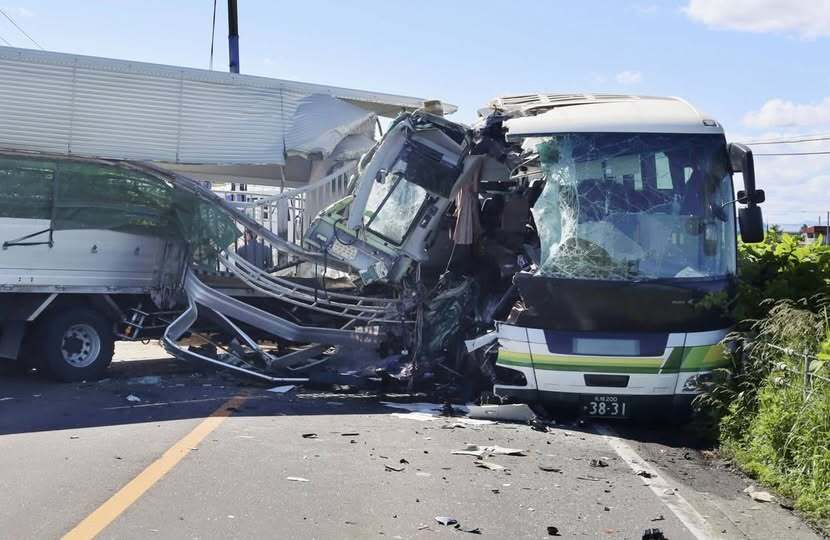
It was supposed to be a routine Sunday journey. The sun was high over the town of Yakumo in Hokkaido, Japan’s northernmost main island. The landscape along National Route 5 is known for its sweeping, quiet beauty—a long stretch of road that connects the bustling city of Sapporo to the coastal charm of Hakodate. For the 15 passengers aboard the Hokuto Kotsu intercity bus, the day promised relaxation, hot springs, and scenic views.
But at approximately 12:00 p.m. on June 18, 2023, that silence was shattered by a sound so loud it was heard miles away. In a split second, a journey of leisure turned into a scene of absolute devastation. A heavy-duty truck, carrying a load of livestock, veered inexplicably into the oncoming lane. There was no time to swerve. No time to scream. The impact was catastrophic.
When the dust settled, the scene looked like something out of a disaster movie. Metal was twisted into unrecognizable shapes. Glass covered the asphalt like frost. And amidst the wreckage of the two vehicles, a surreal and chaotic element added to the horror: pigs, thrown from the back of the livestock truck, were wandering dazed through the crash site.
This isn’t just a story about a traffic accident. It is a chilling reminder of how fragile life is, and how a single moment of distraction or fatigue can alter the destinies of dozens of families forever.
The Collision: A Split-Second of Terror
The bus, operated by Hokuto Kotsu Inc., was known as the “Aurora.” It was a reliable service, popular with tourists and locals alike. Behind the wheel was 64-year-old Koji Koda, a veteran driver with a clean record. He had performed all his safety checks that morning. He was doing everything right.
Approaching from the opposite direction was a truck driven by 65-year-old Makoto Kajiya. He was transporting pigs from Hakodate to a slaughterhouse in Yakumo.
According to dashcam footage recovered later by investigators—footage that would shock the nation—the bus was traveling perfectly within its lane. Suddenly, on a gentle curve, the truck drifted. It didn’t jerk or swerve as if avoiding an obstacle. It simply floated across the center line, crossing directly into the path of the oncoming bus.
There were no skid marks. Police reports later confirmed this chilling detail: the truck driver never hit the brakes. The collision was full-force, head-on. The combined speed of the two massive vehicles created an impact energy that obliterated the front cabins of both the bus and the truck.
For the passengers in the front rows of the bus, there was no escape. The sheer force of the metal crumpling inwards claimed lives instantly.
The Aftermath: Chaos and Confusion
First responders arriving at the scene described a tableau of pure carnage. The front of the bus had effectively ceased to exist, sheared off by the force of the truck. The truck itself was turned on its side, its cargo hold ripped open.
“I heard a bang that sounded like an explosion,” said one local resident who lived near Route 5. “When I looked out, smoke was rising. I knew immediately it wasn’t a normal fender bender.”
Inside the bus, survivors were trapped in a prison of twisted steel. Screams for help mixed with the squeals of the injured pigs that had spilled onto the roadway. The surreal nature of the livestock roaming around the wreckage made the rescue operation even more difficult. Emergency crews had to navigate through the bl00d-stained debris while corralling agitated animals to reach the human victims.
“It was a scene from hell,” one firefighter reportedly told local media. “The front of the bus was just… gone.”
Air ambulances were dispatched from nearby hospitals. Helicopters chopped through the air, landing on the closed highway to evacuate the critically injured. In total, 12 people were rushed to hospitals with varying degrees of injuries. But for five people, help arrived too late.
The Victims: Lives Cut Short
The toll of the crash was heartbreaking. Five people were confirmed dd at the scene or shortly after at the hospital.
Both drivers, Koji Koda (the bus driver) and Makoto Kajiya (the truck driver), were klld instantly. They were men in their 60s, working hard, likely looking forward to the end of their shifts. Koda was described by his colleagues as a gentle, responsible man who took pride in the safety of his passengers. That he died doing exactly what he was supposed to do—driving safely in his lane—adds a bitter layer of tragedy to the event.
Three passengers on the bus also lost their lives. They were identified as:
-
Hiroki Takahashi, 33
-
Kikumi Wakasaki, 57
-
Otomi Kikuchi, 55
These were ordinary people. A young man in his 30s with his whole life ahead of him. Two women in their 50s, perhaps traveling to visit family or enjoy a weekend getaway. They had boarded the bus trusting they would arrive safely. They never made it to their destination.
The randomness of their deaths is what haunts the community most. Had they chosen a seat three rows back, they might have survived. Had the bus been ten seconds slower or faster, the truck might have missed them. It is the terrifying calculus of fate.
The Investigation: Why Did It Happen?
As the families mourned, the police launched a massive investigation. The primary question: Why did the truck cross the line?
The dashcam footage from a car following the bus became the key piece of evidence. It showed the truck drifting smoothly, almost lazily, into the oncoming lane. This behavior is classic in cases of driver incapacitation.
Investigators focused on two main theories:
-
Medical Emergency: Did the truck driver, Makoto Kajiya, suffer a heart attack or stroke moments before the crash?
-
Fatigue/Microsleep: Did he fall asleep at the wheel?
The lack of skid marks suggests he was unconscious or already deceased before the impact. He made no attempt to steer back. He made no attempt to brake.
Police raided the offices of the pig farming company that owned the truck, “Nippon Clean Farm,” searching for records of the driver’s schedule. Was he overworked? Japan has a notorious culture of overwork, and the trucking industry is often at the center of debates regarding driver fatigue. However, initial reports suggested Kajiya had not exceeded legal driving limits in the days prior.
This leaves the medical theory or a sudden, irresistible wave of sleepiness. Route 5 is known for its long, straight sections that can induce “highway hypnosis,” where drivers zone out. But this accident happened on a curve, where attention should have been higher.
The “2024 Problem” and Road Safety
This accident struck a nerve in Japan, occurring right as the country was debating the “2024 Problem”—a looming logistics crisis caused by new laws limiting overtime for truck drivers. While the laws are meant to prevent fatigue-related accidents just like this one, the industry is under immense pressure to move goods faster with fewer hours.
The Yakumo crash became a grim case study. If an experienced driver with a decent record can drift into oncoming traffic in broad daylight, is anyone safe?
Social media in Japan erupted with sympathy and anger. “I take that bus all the time,” one user commented on Twitter. “It could have been me.” Others pointed out the lack of a center divider on that section of the highway. “If there had been a guardrail, the truck would have bounced off. Five people would still be alive.”
The Surreal Detail: The Pigs
In the viral spread of this news, the detail about the pigs captured the world’s attention. It is a detail that seems almost grotesque—animals surviving a crash that kll-ed humans. Reportedly, the truck was carrying around 30 pigs. Many were thrown from the vehicle, suffering injuries, while others wandered the road, confused by the sirens and the carnage.
Local farmers and police had to corral the animals while simultaneously trying to extract victims from the crushed metal. It was a chaotic, muddy, bl00dy scene that underscored the sheer violence of the impact. The juxtaposition of agricultural life and high-speed mechanical death created an image that few witnesses will ever forget.
A Warning for Us All
The tragedy on Route 5 serves as a universal warning. We often feel safe in our vehicles, protected by airbags and steel frames. But when heavy machinery collides at high speeds, those protections mean very little.
For the families of the five who d-ied, the pain is immeasurable. A Sunday afternoon phone call changed their lives forever. For the survivors, the trauma of that impact, the sound of the crash, and the screams that followed will linger for a lifetime.
As we drive, we share a silent pact with every other driver on the road: Stay in your lane. Stay awake. Stay alive. In Yakumo, on that fateful June day, that pact was broken, and the cost was catastrophic.
Drive safe. Hug your loved ones. You never know when a routine journey could be your last.