
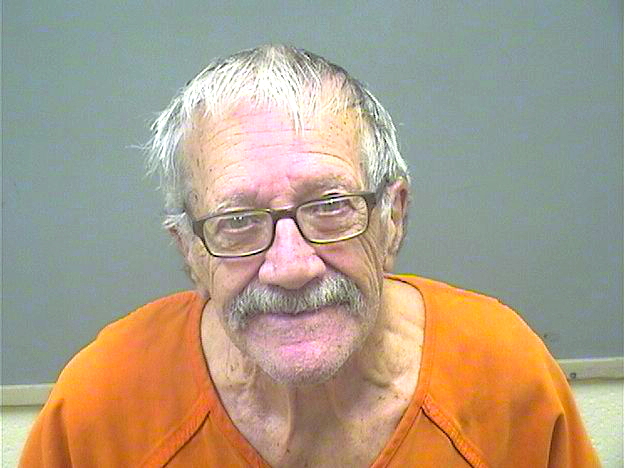
It was a Wednesday morning in Austintown, Ohio, when 83-year-old Forrest Lytell walked into the PNC Bank on Mahoning Avenue. He wasn’t wearing a mask. He didn’t run in screaming. He simply walked up to the teller with the slow, steady gait of a man who had carried the weight of the world on his shoulders for far too long.
He handed the teller a note. It was scribbled with a demand that would change the rest of his life: “Give me all the money or else.”
Forrest Lytell, a veteran of both the U.S. Navy and Army with a spotless record, had just become a bank robber. But unlike the criminals we see in movies, Forrest wasn’t looking for a life of luxury. He was looking for a way to keep his wife alive.
This is the heartbreaking true story of a man pushed to the brink by a system that failed him, and the incredible mercy that followed.
“How Did You Find Me So Fast?”
The robbery itself was over in minutes. The terrified teller, following protocol, handed Forrest a bag containing $319 in cash. Unbeknownst to Forrest, the stack of bills included “bait money”—cash equipped with a hidden GPS tracker designed to lead police straight to the perpetrator.
Forrest took the money and left. He didn’t have a getaway driver. He didn’t have a complex escape plan. he simply drove toward his home on South Anderson Avenue, just a few miles away.
The Austintown Police Department, tracking the GPS signal, swarmed the area almost immediately. When officers located the elderly man near his shed, trying to hide the bag of money, they didn’t find a hardened criminal putting up a fight. They found a confused, exhausted senior citizen.
As Officer Sgt. Rick John approached him, Forrest didn’t run. He didn’t reach for a gn. He simply looked up at the officers with genuine confusion and asked a question that broke the hearts of everyone on the scene:
“How did you guys find me so fast?”
He was arrested without incident, still wearing his everyday clothes, and taken into custody.
The Real Motive: A Love Story Turned Tragedy
Once Forrest was sitting in the interrogation room, the layers of this “crime” began to peel away, revealing a tragedy that is all too common in America today.
Forrest wasn’t a thief. He had lived in Austintown for over 40 years without so much as a parking ticket. He was a proud veteran who had served his country honorably. But in his final years, he was facing an enemy he couldn’t defeat: medical debt.
Forrest’s wife of 47 years was suffering from severe dementia. For the past year, she had been under constant medical care, recovering from surgeries and needing specialized attention that Forrest, at 83, struggled to provide alone.
The costs were mounting. The stress was crushing. Forrest was drowning in bills, and his fixed income from Social Security wasn’t enough to keep the lights on and his wife cared for.
“I was trying to find some help to maybe ease things at home and ease things around me,” Forrest later told reporters. “I hit a breaking point.”
Isolated, overwhelmed, and feeling like he had no other options, the old soldier made a desperate calculation. He would rob a bank, not out of greed, but out of love.
A Community Stunned
When the news broke, the community of Austintown was in shock. People who knew Forrest described him as a gentle, quiet neighbor. His wife, upon hearing the news, was devastated.
“I couldn’t believe it,” she said through tears. “I love him with every bit of my being. He was just overwhelmed.”
The image of the 83-year-old in an orange jumpsuit, standing before a judge, went viral. It sparked a furious debate online. How could a man who served his country be left so desperate that he felt he had to commit a felony just to survive?
Commenters flooded social media with support:
-
“This isn’t a crime; it’s a cry for help.”
-
“He fought for us, why didn’t we fight for him?”
-
“Release him! He was trying to save his wife!”
But the law is the law. Forrest was charged with robbery and inducing panic. He faced up to 8 to 10 years in prison—a sentence that, at his age, would effectively be a life sentence. He would likely d*e behind bars, separated from the wife he tried so hard to save.
The Verdict: Mercy in the Courtroom
In a twist that restored faith in humanity for millions watching the case, the justice system looked at the man, not just the crime.
During his court appearance, Forrest was humble. He admitted his guilt immediately. “If I had to do it again, I wouldn’t. That’s the whole thing about it,” he said softly.
Judge D’Apolito, presiding over the case, saw that sending an 83-year-old veteran with dementia symptoms of his own to prison would serve no one. It wouldn’t make the community safer, and it would destroy a family already on the brink.
In a rare and compassionate move, the Judge offered Forrest a lifeline: Veterans Court.
Instead of prison, Forrest was sentenced to a diversion program specifically designed for veterans who find themselves on the wrong side of the law due to mental health or trauma.
-
He would avoid jail time.
-
He would receive support from veteran mentors.
-
He would have to check in every two weeks for a year.
-
If he completed the program, his record would be wiped clean.
“If you don’t accept the program, you’d have a chance of going to prison for 8-10 years. That’s a long time,” Forrest acknowledged. “The veterans are going to help. They’re going to help a lot.”
“I Came Out Pretty Good”
Today, Forrest Lytell is back home. He isn’t a millionaire; the financial struggles didn’t magically disappear. But he is free, and he is with his wife.
The $319 he stole was returned to the bank. The panic he caused has settled. But the message he left behind still rings loud and clear.
This story forces us to ask uncomfortable questions. How many other seniors are one medical bill away from desperation? How many veterans are suffering in silence, too proud to ask for help until they break?
Forrest Lytell’s story isn’t just about a bank robbery. It’s about the lengths a human being will go to for the person they love. It is a reminder that sometimes, justice isn’t about punishment—it’s about understanding.
As Forrest told reporters after his release, reflecting on the second chance he was given: “I feel like I came out pretty good on this situation.”
For a man who thought he had lost everything, that second chance meant the world.