
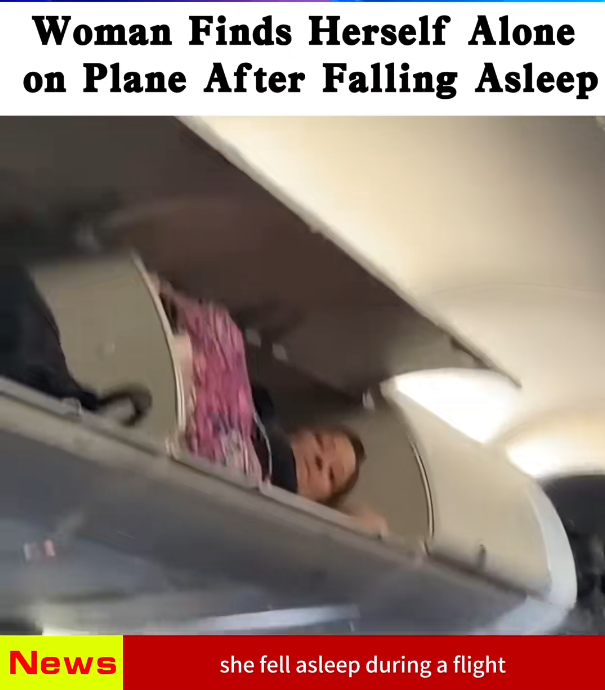
It is a scenario that sounds like the opening scene of a psychological thriller. You settle into your seat, the hum of the jet engines lulls you into a deep sleep, and you expect to be nudged awake by a flight attendant or the sound of passengers deplaning. But for one woman, the reality was a cold, dark, and terrifying nightmare.
Tiffany Adams recently lived through what many travelers would consider their ultimate fear. After falling asleep during a routine flight to Toronto, she woke up hours later to a world of absolute silence and pitch-black darkness. She wasn’t at her terminal, and she wasn’t in her bed. She was still on the plane—locked, abandoned, and entirely alone.
The story has since sent shockwaves through the travel industry, raising serious questions about airline safety protocols and how a passenger could simply be “forgotten” in the age of high-security travel.
The Flight That Didn’t End
The ordeal began like any other trip. Tiffany was traveling on an Air Canada flight destined for Toronto’s Pearson International Airport. It was a relatively short flight, and like many weary travelers, she decided to catch some shut-eye during the journey.
According to reports and Tiffany’s own harrowing account, she fell into a deep sleep about halfway through the trip. When she finally opened her eyes, the experience was disorienting. There was no cabin light, no chime from the pilot, and no sound of engines.
“I thought this is a nightmare, this is not happening,” she later shared. The cabin was freezing, and when she tried to look around, she realized the aircraft was completely powered down. She was strapped into her seat in a literal “ghost plane” parked far from the terminal.
A Race Against Silence and a Dying Phone
Panic quickly set in as Tiffany realized the gravity of her situation. Her first instinct, naturally, was to reach for her phone. She needed to call for help, to tell someone she was trapped in a multi-million dollar piece of machinery that had been “tucked in” for the night.
However, her nightmare took another turn for the worse. Her phone was nearly dead. In the pitch-black cabin, she frantically tried to plug her phone into the seat’s USB port, only to realize that because the plane was completely shut down, there was no power running to the outlets.
She managed to send a quick, panicked text to a friend, explaining that she had woken up alone on the plane. At first, her friend didn’t believe her, thinking it was a joke or a strange dream. But as the messages became more frantic, the reality set in.
“I’m stuck by myself alone on a plane,” she messaged. Her friend immediately began calling the airport, but Tiffany was left in the dark, her phone finally dying, leaving her in total isolation.
The Cockpit and the Flashlight
Determined not to spend the night trapped in the freezing cabin, Tiffany began fumbling through the dark. She described the experience as “pitch black,” making every movement a challenge. She eventually made her way to the front of the aircraft.
In an incredible stroke of luck, Tiffany managed to enter the cockpit. While she was careful not to touch anything that might compromise the aircraft’s systems, she began searching for anything that could help her signal for help.
That was when she found it: a manual flashlight.
“I found the flashlight and I was so happy,” she recounted. “That was like the best moment ever.” Armed with a source of light, she now had a tool to fight the darkness, but she was still locked inside a pressurized tube with no way out.
The Daring Escape
Tiffany eventually made it to one of the main cabin doors. After some effort, she managed to unlatch the heavy door and swing it open. However, her relief was short-lived. Between her and the tarmac was a drop of nearly 40 to 50 feet. Without a jet bridge or stairs, she was still a prisoner of the plane.
She spent a significant amount of time sitting in the open doorway, dangling her legs over the edge and frantically waving her flashlight into the night. She hoped that someone—anyone—patrolling the tarmac would see the strange light coming from a plane that was supposed to be empty.
Finally, her persistence paid off. A baggage handler driving a luggage cart spotted the flickering light. According to reports, the worker was stunned to find a passenger hanging out of the door of a “dead” aircraft.
“He was in shock,” Tiffany said. “He asked how the heck I was still on the plane.”
Security Concerns and a Failing Protocol
The incident has sparked an intense debate regarding airline security. How does a flight crew perform a final walkthrough and miss a passenger still sitting in their seat? Standard operating procedures for almost every airline in the world require a thorough sweep of the cabin to ensure no luggage, or people, are left behind.
Authorities and aviation experts are now looking into the timeline of the “ghost flight.” If a passenger can be left behind, the implication is that security checks are not as rigorous as the public is led to believe.
Air Canada has reportedly reached out to Tiffany to offer their apologies and has launched an internal investigation into the matter. However, for Tiffany, the emotional toll has been significant. She described the incident as traumatic, noting that the feeling of being “forgotten” and “trapped” is something that doesn’t just go away.
A Lesson for Every Traveler
While Tiffany’s experience is rare, it serves as a stark reminder of the “human element” in travel. Despite all the technology and safety checks, mistakes can happen.
The story has since gone viral, with thousands of people sharing their own “travel horror stories.” However, few can compare to the sheer isolation of being locked in a dark airplane at midnight.
Public reaction has been a mix of horror and disbelief. “I would have lost my mind,” one social media user commented. “This is why I never sleep until I’m through the gate.”
As the investigation continues, travelers are being reminded to stay vigilant. While it shouldn’t be the passenger’s job to ensure they aren’t left behind, the reality is that system failures occur.
The Aftermath
Tiffany Adams is safe now, but she is understandably shaken. The flight that was supposed to be a simple journey home turned into a life-altering event.
The aviation industry will likely use this incident to tighten their “deplaning” protocols. For now, Tiffany’s story remains a chilling example of what happens when the lights go out and the world moves on without you.
It raises the question we all might ask ourselves the next time we board a flight: Do we really know who—or what—is left behind when the cabin doors are locked?