
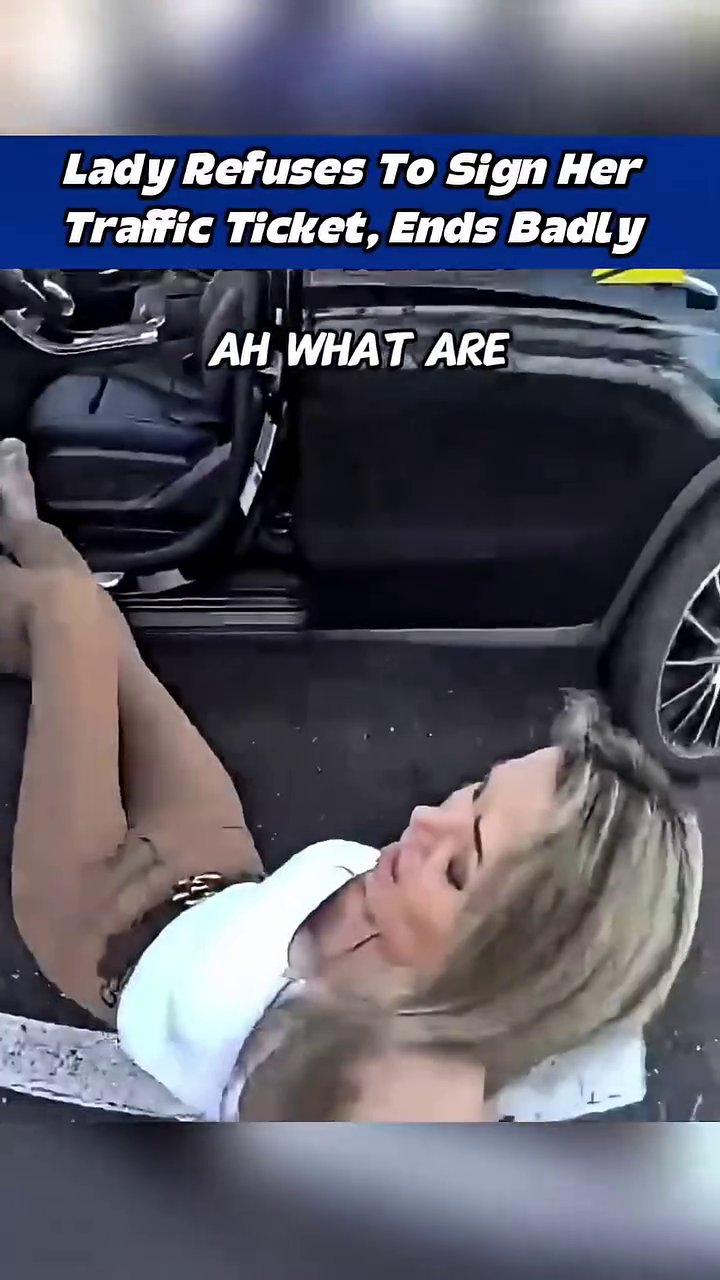
Getting pulled over is an experience most drivers dread. Usually, the routine is simple: provide your license and registration, wait for the officer to process the paperwork, accept the ticket, and move on with your day. However, a recently released bodycam video shows exactly what happens when a simple traffic stop turns into a full-blown confrontation due to a driver’s refusal to comply with basic legal procedures.
What started as a routine stop for speeding ended with a woman being forcibly removed from her vehicle and placed under arrest—all because she refused to sign a piece of paper.
The Initial Stop: 75 in a 40?
The incident began when an officer on a motorcycle pulled over a luxury black sedan. The driver, a blonde woman, appeared surprised as the officer approached her window.
“Hello, you’re in a big hurry this morning,” the officer remarked.
The driver’s excuse was a common one: she was running late for work. “I’m going to work, my job is over there,” she said, pointing down the road. When the officer asked how fast she thought she was going, she confidently replied, “Forty.”
The officer’s response was a wake-up call. “No. Seventy-five,” he corrected her. He explained that he had clocked her going 75 miles per hour while traveling under an overpass—a significant margin over the speed limit. Despite her apologies and repeated claims that she was just trying to get to work, the officer proceeded with the standard investigation, asking for her driver’s license and proof of insurance.
The Insurance Complication
The situation hit its first snag when the driver was unable to provide immediate proof of insurance. While she handed over her license, she began fumbling through papers and her phone to find a valid insurance card.
After a few minutes of waiting, the officer returned to his motorcycle to write the citations. In many jurisdictions, driving without proof of insurance is a secondary offense that can lead to vehicle impoundment or heavy fines, adding more stress to an already tense situation.
When the officer returned to the driver’s window, he informed her that he was issuing tickets for both the speeding violation and the lack of proof of insurance. This is where the cooperation ended and the confrontation began.
The Standoff: “Give Me A Minute”
In many states, signing a traffic ticket is not an admission of guilt. Instead, it is a legal acknowledgement that you have received the citation and a promise to either pay the fine or appear in court. Refusing to sign the ticket is often viewed as a refusal to promise to appear, which gives the officer the legal authority to take the driver into custody.
The officer explained this clearly: “You have to sign these, or you go to jail.”
Rather than signing, the driver began to stall. “Give me a few minutes, okay?” she asked, appearing to be on her phone or distracted by her belongings.
The officer, showing a degree of patience, waited. However, as the minutes ticked by, his patience wore thin. The video shows a jump in time, indicating that the officer stood by the window for nearly ten minutes while the driver continued to argue and ignore the command to sign.
“You sign these or you come with me,” the officer warned again.
“Give me a minute, sir,” she repeated, holding her hand up to dismiss him.
“There is no ‘minute.’ We’ve been here for ten minutes already,” the officer replied.
The Escalation and Forced Removal
The turning point came when the officer realized the driver had no intention of complying. In law enforcement, a traffic stop is a “temporary seizure.” Officers are trained to conclude these interactions as quickly and safely as possible. When a driver refuses to sign a ticket and refuses to exit the vehicle, it creates a safety risk and a legal stalemate.
“Let’s go. Out of the car,” the officer commanded, opening the driver-side door.
The driver’s demeanor shifted from dismissive to panicked. “What do you mean ‘let’s go’? You can’t pull me out… Don’t touch me!” she screamed.
Despite her protests, the officer reached into the vehicle to unbuckle her seatbelt and lead her out. The driver continued to resist, pulling her arm away and shouting for help. Within seconds, the officer had her out of the car and on the pavement.
As the reality of the situation set in—and the handcuffs were being prepared—the driver suddenly changed her tune. “Give me the ticket! I’ll sign it!” she yelled while being restrained.
But for the officer, the window of opportunity for a simple signature had closed. “No, we already passed that point,” he said firmly.
Why Signing the Ticket Matters
This viral incident serves as a stark reminder of the legal obligations drivers have during a traffic stop. Many people mistakenly believe that by signing a ticket, they are “pleading guilty” on the spot. This is a misconception that often leads to unnecessary arrests.
Legally, the signature is a “Written Promise to Appear.” If you refuse to sign, the officer cannot technically release you on your own recognizance because you haven’t “promised” to handle the matter in court. Consequently, the only way the officer can ensure the legal process is followed is to physically bring you before a magistrate—which means being handcuffed and taken to jail.
The Psychology of the “Entitled” Driver
Social media reactions to the video have been polarized, though the majority of viewers side with the officer. Critics of the driver point to her “entitled” behavior, noting that she seemed to believe her need to get to work or her personal timeline took precedence over the law.
The “give me a minute” defense is one that rarely works in a law enforcement context. When an officer gives a lawful order—such as “exit the vehicle” or “sign this document”—it is not a suggestion or the start of a negotiation.
On the other hand, some viewers argued that the officer could have waited longer or used more de-escalation tactics. However, law enforcement experts point out that the officer had already waited ten minutes, which is far beyond the standard duration for a signature.
The Aftermath
The video concludes with the woman being led away, her car likely destined for an impound lot, and a simple speeding ticket transformed into a criminal charge for obstruction or resisting an officer without violence.
What could have been a
200−300 fine and a few points on her license turned into a permanent criminal record, legal fees, and the trauma of a physical arrest.
Lessons for the Public
This incident highlights three crucial rules for any traffic stop:
-
Comply Now, Contest Later: The side of the road is not the place to argue the facts of a case. If you believe the officer is wrong about your speed, the place to prove that is in a courtroom, not during the stop.
-
Understand the Signature: Always sign the ticket. It protects you from being taken to jail and does not prevent you from fighting the ticket in court later.
-
Keep Your Hands Visible and Follow Commands: Escalation often happens when a driver reaches for items or refuses to exit the vehicle. Following instructions promptly is the fastest way to end the encounter.
In the end, this driver learned a hard lesson in the “Find Out” phase of “Mess Around and Find Out.” The officer’s bodycam caught every second of the transition from a routine morning commute to a life-changing legal disaster.
As the officer noted in the video, they had “already passed the point” of negotiation. Once a lawful order is ignored and the officer begins the arrest process, there is usually no going back—even if you finally agree to sign the paper.