
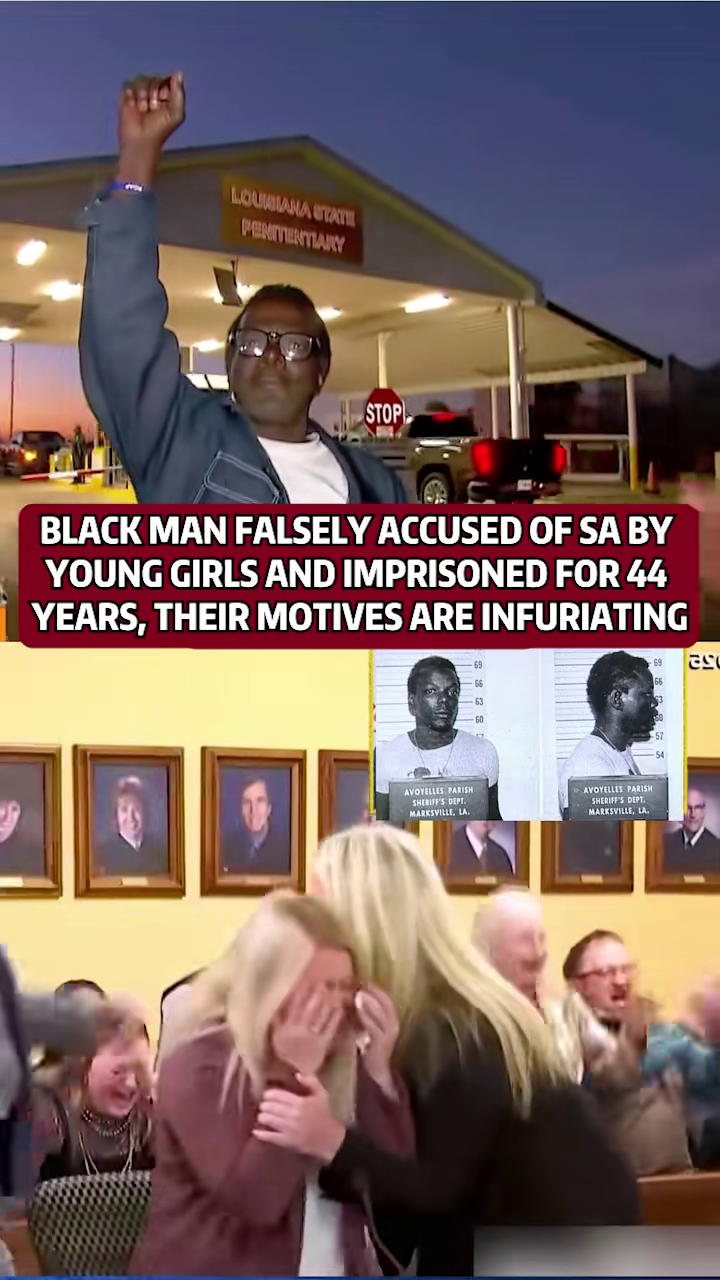
The image of Vincent Simmons walking out of the Louisiana State Penitentiary, commonly known as Angola, is one that burns into the memory. With his fist raised high and a look of weary triumph on his face, he stepped into a world that had moved on without him for nearly half a century. At 70 years old, Simmons had spent more time behind bars than he had as a free man. His crime? Nothing. His sentence? A century of hard labor.
The story of Vincent Simmons is not just a tale of a legal mistake; it is a harrowing indictment of a justice system that, for decades, prioritized a narrative over the truth, and a chilling reminder of how easily a life can be discarded based on false accusations.
1977: The Night That Changed Everything
In May 1977, the town of Marksville, Louisiana, was rocked by an allegation involving two 14-year-old white twin sisters. They claimed that a Black man had stopped them on a secluded road and committed a brutal act of SA. In the racial climate of the 1970s South, such an accusation was a lightning rod for immediate and aggressive police action.
Vincent Simmons, then 25, was arrested shortly after. From the very beginning, the “investigation” was marred by procedural failures and outright brutality. During his interrogation, Simmons maintained his innocence. In a shocking display of violence, a deputy sheriff shot Simmons in the chest while he was in custody. He survived the attempt on his life, but the message was clear: the authorities had already decided he was guilty.
A Trial Built on Shadows
When the case went to trial, the prosecution’s evidence was non-existent. There were no fingerprints, no DNA (which was not yet available, but other biological evidence could have been tested), and no independent witnesses. Simmons, however, had an alibi. Multiple people could place him elsewhere at the time of the alleged attack.
The most damning part of the trial was the identification process. During a lineup, the twin sisters were asked to identify their attacker. According to court records and later interviews, the sisters were unable to provide a detailed description of the man. Their justification for the identification was a sentiment that highlighted the deep-seated prejudice of the era: they claimed that all Black people “looked the same.”
Despite the lack of evidence and the questionable identification, an all-white jury took only a short time to find Simmons guilty. He was sentenced to 100 years in prison without the possibility of parole.
The Long Dark Night of Angola
For the next 44 years, Vincent Simmons lived within the walls of the Louisiana State Penitentiary. Known as one of the most brutal prisons in America, Angola is a former slave plantation, and for Simmons, it became a tomb for his youth, his middle age, and his dreams.
Simmons never stopped fighting. He became a “jailhouse lawyer,” studying the law to understand how he could overturn his conviction. He filed appeal after appeal, only to be met with rejection after rejection. The system that had so efficiently locked him away proved to be incredibly sluggish and resistant when it came to re-examining his case.
The 1993 Discovery: Evidence of Innocence Withheld
The most frustrating turning point in Simmons’ journey occurred in 1993. Through his own persistent efforts, he managed to obtain medical records from the night of the alleged crime in 1977. These records, which had been in the possession of the state for decades, were explosive.
The medical examination conducted on the twin sisters immediately after the reported incident showed no physical evidence of an assault. In fact, the examining physician noted that there were no signs of trauma or any biological evidence that supported the sisters’ story.
This evidence should have triggered an immediate release. However, the legal hurdles remained immense. The state argued that the evidence was not “newly discovered” in a way that met the strict legal criteria for a new trial, despite the fact that it had been suppressed during the original proceedings. Simmons remained in prison for another 29 years after this discovery.
2022: The Walls Finally Come Down
The tide finally turned when the Innocence Project and dedicated legal advocates took up Simmons’ cause. They highlighted not only the suppressed medical evidence but also the inherent flaws in the original identification and the systemic bias that led to his conviction.
In 2022, a judge finally vacated Simmons’ conviction. The prosecution acknowledged that the original trial was fundamentally unfair and that the evidence used to convict him would never stand up in a modern courtroom. After 44 years, Vincent Simmons was a free man.
The Absence of Remorse
One of the most infuriating aspects of this case is the aftermath. When a person is exonerated after such a long time, there is often a hope for a sense of closure or an apology from those who caused the harm. In the case of Vincent Simmons, that closure has been elusive.
The twin sisters, now grown women, have refused to apologize or acknowledge that their accusations were false. In interviews following Simmons’ release, they maintained that they were the victims. They told reporters that they still suffer from “psychological trauma” and have shown no sympathy for the man who lost four decades of his life because of their testimony.
Furthermore, because of Louisiana’s restrictive compensation laws, Simmons has faced an uphill battle in receiving any financial redress for the decades he spent in a 6×9 cell. He walked out of prison with nothing but the clothes on his back and the support of his family.
The Broader Impact: A Systemic Failure
The case of Vincent Simmons is a textbook example of how the justice system can fail when it is influenced by racial bias and a “conviction at all costs” mentality. It highlights several critical issues that still plague the American legal system today:
-
Suppression of Evidence: The fact that medical records proving innocence were held by the state for 16 years before Simmons saw them—and then ignored for another 29—is a grave violation of due process.
-
Cross-Racial Identification: Studies have consistently shown that eyewitness identification is often unreliable, particularly when the witness is identifying someone of a different race. The “they all look the same” defense is a relic of prejudice that has no place in a court of law.
-
The Difficulty of Exoneration: It shouldn’t take 44 years to undo a mistake, especially when proof of that mistake exists. The legal barriers to proving innocence after a conviction are often higher than the barriers to proving guilt during a trial.
Life After 44 Years
Since his release, Vincent Simmons has been adjusting to a world that looks nothing like the one he left in 1977. When he went to prison, there were no cell phones, no internet, and the political landscape was entirely different. He has had to learn how to navigate a modern society while mourning the loss of his parents and other family members who passed away while he was incarcerated.
Despite the unimaginable hardship he has endured, Simmons has shown incredible grace. He has spoken about the importance of forgiveness, not necessarily for the sake of those who wronged him, but for his own peace of mind. “I can’t carry that weight,” he once remarked regarding the anger he could feel.
A Call for Reform
The story of Vincent Simmons serves as a rallying cry for criminal justice reform. It underscores the need for:
-
Open File Discovery: Ensuring that defense attorneys have access to all evidence held by the state from the beginning.
-
Conviction Integrity Units: Specialized offices within district attorney’s offices dedicated to investigating claims of innocence.
-
Fair Compensation Laws: Ensuring that those who are wrongfully imprisoned are given the resources they need to rebuild their lives.
Conclusion
Vincent Simmons’ 44-year journey from a 25-year-old victim of a false accusation to a 70-year-old exonerated man is a testament to the human spirit’s resilience. However, it is also a somber reminder of the lives destroyed by a system that fails to protect the innocent.
As Vincent continues to advocate for others who are wrongfully convicted, his story remains a vital chapter in the ongoing struggle for true justice in America. We must look at his raised fist not just as a sign of his personal victory, but as a demand for a system that ensures no one else ever has to wait 44 years to hear the words “not guilty.”
What do you think about Vincent’s story? Should there be harsher penalties for those who provide false testimony that leads to decades of imprisonment? Tell us your thoughts in the comments.