
In the age of social media, it has become very common for people to stumble upon unusual-looking objects and immediately ask the internet for answers. Whether it is an old household tool, a forgotten industrial device, or a strange piece of metal found in storage, these moments often turn into viral discussions. What seems confusing at first usually has a very practical explanation rooted in history.
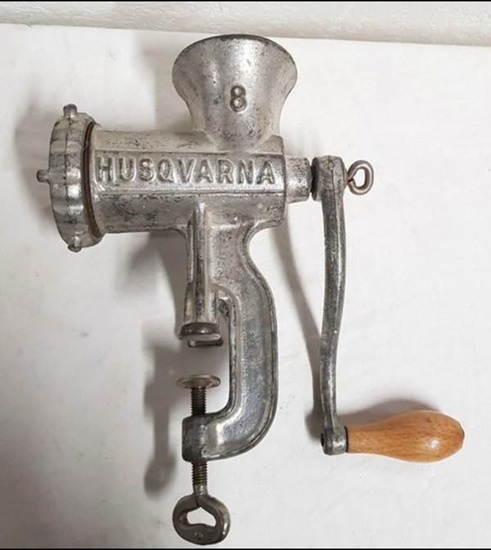
One such object that frequently confuses people online is a mechanical kitchen tool made of steel, often attached to a table. At first glance, it can look complex or even intimidating to someone unfamiliar with traditional kitchen equipment. However, the internet community often quickly identifies it and explains its purpose in detail.
This specific object is known as a meat mincer, also commonly called a meat grinder in many countries. Despite its simple appearance, it has played an important role in food preparation for over a century.
What a Meat Mincer Actually Is
A meat mincer is a manual or electric kitchen device designed to grind or finely chop meat into smaller pieces. It typically consists of a metal body, a rotating mechanism, a feeding tube, and a perforated plate at the end. When meat is pushed through the machine and processed, it comes out in finely minced strands.
Originally, these devices were entirely manual and required physical effort. A handle would be turned repeatedly to rotate an internal blade that presses meat through small holes. This simple but effective mechanism allowed households and butcher shops to prepare fresh minced meat without relying on industrial processing.
Over time, the design evolved, and electric versions were introduced. These modern machines significantly reduced effort and increased efficiency, allowing large quantities of meat to be processed quickly and consistently.
Historical Origins and Development
The concept of mechanically grinding meat dates back to the 19th century. Early versions of the meat mincer were developed during a time when food preparation was becoming more standardized and efficient due to industrial innovation.
One of the early contributors to mechanical food processing was Karl Drais, a German inventor known for creating various mechanical devices during the 1800s. While early meat grinders were relatively simple, they laid the foundation for modern kitchen appliances.
In their earliest form, meat mincers were made entirely of cast iron or steel. They were clamped onto tables or countertops, and users manually turned a crank to process meat. This method was widely used in households, butcher shops, and even small restaurants.
As industrial technology advanced, manufacturers refined the design to improve durability, hygiene, and ease of use. By the early 20th century, meat mincers had become a common household tool in many parts of Europe and North America.
How Traditional Manual Meat Mincers Work
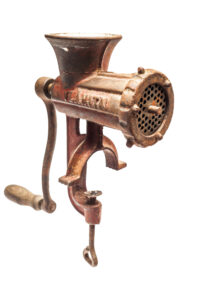
The manual meat mincer operates using a very straightforward mechanical principle. First, pieces of meat are placed into a feeding chamber at the top of the device. Then, a rotating handle turns a screw-like mechanism inside the machine.
As the screw rotates, it pushes the meat forward toward a sharp cutting blade. The blade slices the meat, forcing it through a perforated metal plate at the end. The size of the holes in this plate determines how fine or coarse the minced meat will be.
This process repeats continuously as long as the handle is turned. Although it requires effort, the design is efficient, reliable, and does not require electricity.
Because of its simplicity, this type of grinder became widely used in homes before electric appliances became common.
The Transition to Electric Meat Grinders
With the rise of electricity in households during the 20th century, kitchen appliances began to change rapidly. Meat mincers were no exception. Electric motors replaced manual cranking systems, making the process faster and more convenient.
Electric meat grinders operate on the same basic principle as manual ones, but the internal screw and blade are powered by a motor. This allows large quantities of meat to be processed in a short time without physical effort.
Modern versions also come with multiple attachments. These can be used for making sausages, grinding vegetables, or even preparing specialty dishes from different cuisines. Some advanced models include different speed settings, safety features, and stainless-steel components for easier cleaning.
Today, electric meat grinders are commonly found in both home kitchens and commercial food industries.
Why Meat Mincers Were So Important in the Past
Before the invention of modern food processing equipment, preparing minced meat required significant manual effort using knives. This was time-consuming and often inconsistent. The introduction of the meat mincer changed this completely.
It allowed people to prepare fresh minced meat at home, ensuring better control over quality and hygiene. Butchers could also serve customers faster and more efficiently. In many households, especially in Europe, owning a meat mincer became a symbol of practical kitchen efficiency.
It also contributed to the development of many traditional recipes that rely on minced meat, such as sausages, meatballs, and stuffed dishes.
Why People Still Get Confused by It Today
In modern times, many people have never seen a manual meat grinder because electric appliances have replaced them. As a result, when older tools like this appear in attics, antique shops, or online posts, they can seem unfamiliar.
The confusion often comes from the tool’s industrial appearance. Its heavy metal structure and mechanical parts can make it look like machinery rather than a kitchen item.
However, once explained, people are often surprised to learn how common and important it once was in everyday cooking.
A Perfect Example of Internet Collaboration
One of the most interesting aspects of these online mysteries is how quickly people come together to solve them. A single post showing an unknown object can attract hundreds of comments from individuals sharing knowledge, personal experience, or historical context.
This collective problem-solving highlights how the internet has become a space not only for entertainment but also for education and shared knowledge. What starts as confusion often ends as a learning moment for thousands of people.
The meat mincer may look like a strange or complicated device to someone seeing it for the first time, but its purpose is simple and practical. It represents an important step in the evolution of food preparation technology.
From its manual beginnings in the 19th century to the advanced electric models used today, it has remained a useful kitchen tool for generations. Its story is a reminder that many everyday objects have long and fascinating histories behind them.
What once caused confusion online is now understood as a clever invention that helped shape modern cooking as we know it.